
Call us
301-363-4651 (Available 9 a.m. to 5 p.m. CST from Monday to Friday)

| Code | CSB-RA010418A02me1HU |
| Size | US$210 |
| Order now | |
| Image |
|
| Have Questions? | Leave a Message or Start an on-line Chat |
| Application | Recommended Dilution |
|---|---|
| WB | 1:500-1:2000 |
| ICC | 1:50-1:500 |
| IF | 1:30-1:200 |
Histone H3.1 is a core component of the nucleosome and serves as a critical platform for post-translational modifications that regulate chromatin structure and gene expression. Mono-methylation at arginine 2 (R2me1) represents a key epigenetic mark involved in transcriptional regulation, making it an important target for researchers investigating chromatin dynamics, gene silencing mechanisms, and epigenetic signaling pathways.
This recombinant monoclonal antibody, clone 4G5, offers the consistency and reproducibility that demanding epigenetic studies require. Produced using recombinant technology with a sequence-defined rabbit IgG framework, this antibody eliminates the lot-to-lot variability that can compromise longitudinal studies or multi-site collaborations. The defined sequence ensures that your experimental conditions remain transferable across projects without the need for re-optimization.
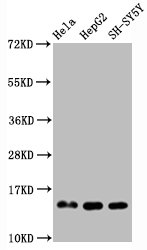
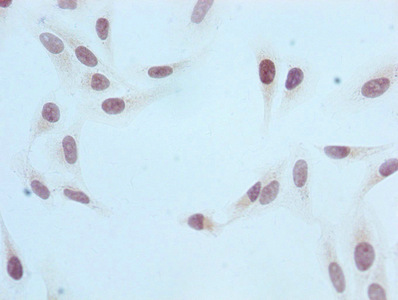
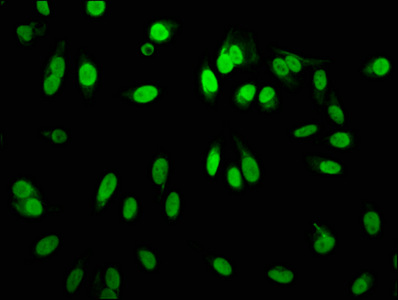
Validation across multiple applications provides flexibility for diverse experimental workflows. In western blot analysis, this antibody detects a clean 15 kDa band corresponding to the predicted molecular weight of Histone H3.1, with successful detection demonstrated in HeLa, HepG2, and SH-SY5Y whole cell lysates at working concentrations of 0.95 μg/ml. For cellular localization studies, immunocytochemistry and immunofluorescence protocols have been optimized in HeLa cells, revealing the expected nuclear staining pattern consistent with histone localization.
The antibody is supplied in a stabilized liquid format containing glycerol for convenient long-term storage, and its unconjugated format allows pairing with your preferred secondary detection system. Whether you are mapping histone modification landscapes, investigating arginine methyltransferase activity, or exploring epigenetic contributions to disease states, this antibody provides a reliable tool for advancing your research in epigenetics and nuclear signaling.
There are currently no reviews for this product.





